Tuesday, November 01, 2011


Sunday, October 23, 2011
on the ground

This is, or was, a dusky pygmy rattlesnake. I found him (or her) dead in the road, but he (or she) wasn't squashed, so I'm not sure what did him (or her) in. Still, we know life goes on long after the asphalt laying machine leaves.
Saturday, October 22, 2011
South Gulf Cove, Port Charlotte, FL

The biggest landmark is a radio tower, visible in the upper right.


the sign advises the general public that this lot is under 24 hour video surveillance.

I have a odd attractive to turkey buzzards. Whenever I see them, I will stop and try to photograph them, but the movement of me setting up a camera and sneaking close to them usually spooks them and they fly away. I have no idea what they where doing on top of this little mound, other than playing their version of king of the hill. Still, actually getting setup to photograph without scaring off a naturally timid bird is an accomplishment to me.
Saturday, October 15, 2011
in the air


So while out, I spy this plane, probably out of Miami, headed northwest, and dragging long contrails. I stopped what I was doing and watched it traverse the sky, all the while leaving a trail.
I've explored with the interaction of planes and the sky before. I guess there's still some attraction to that combination. It seems so pure, so clean, such a elegant act even though it seems like a violation of the sky.
Thursday, September 08, 2011

Friday, September 02, 2011
North Port, Florida Part II


Tuesday, August 23, 2011
North Port, Florida Part I
There's this road that I-75 passes over between North Port and Port Charlotte. I've probably driven over this road a few dozen times, and if this was rural Georgia or South Carolina or Tennessee, I would assume, more than likely, that the road was a county road, leading off to some farm or pasture down the road.
Since this is Florida, that's not the case. The road is actually Yorkshire Street, a main thoroughfare for a development whose name has been seemingly lost, but whose roads remain.


There's a series of bridges in the area, crossing what are labelled as waterways. 20+ years of plant growth, however, have rendered them useless for navigation in all but a shallow draft canoe. This is the bridge crossing the Bethlehem Waterway.

A view of the Bethlehem Waterway. There where several alligators calling, although I never saw them.

A view of the Cocoplum Waterway.

Again, the usual dumping you find in these unintended rural area.


Cruising these streets, I found an odd thing: a grouping of pine trees, planted more or less in a row and more or less evenly spaced. This presents a mystery: Who planted these trees, and why?

Sunday, August 14, 2011

Sunday, July 10, 2011
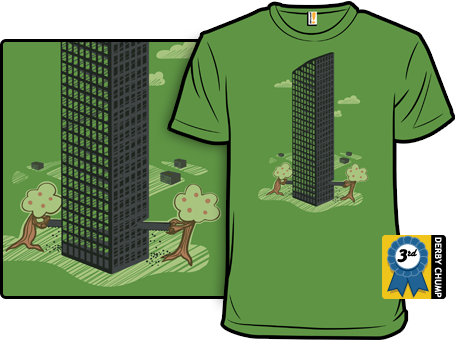
Need more land t-shirt
sometimes there's a sign that you're doing the right thing. Sometimes that sign is a t shirt.

Sunday, July 03, 2011


Saturday, July 02, 2011
Arborwood, Fort Myers, FL
I hate to think that jadedness has started to set in concerning this project of mine, but it has. I've seen countless acres of half developed land that'll probably sit in the state for the remainder of my lifetime, if not longer.
View Larger Map

Here's a typical thing I've seen countless times: A rancher owns land that he grazes his herd on. He sells the land to a developer, and then the market crashes. The developer, facing paying ass high taxes on residential land, rents the land to a "livestock management" company, who puts the minimum number of cattle on the land to retain the farm tax rate while the developer waits for the market to turn around.
At least the rancher made a pretty penny on the deal. The rest of us, not so much.

View Larger Map

Here's a typical thing I've seen countless times: A rancher owns land that he grazes his herd on. He sells the land to a developer, and then the market crashes. The developer, facing paying ass high taxes on residential land, rents the land to a "livestock management" company, who puts the minimum number of cattle on the land to retain the farm tax rate while the developer waits for the market to turn around.
At least the rancher made a pretty penny on the deal. The rest of us, not so much.

Friday, July 01, 2011
Lehigh Acres, Florida, Part II
I'm encouraged by what I've seen in Lehigh Acres, not by man's action toward the landscape, but the action of nature reclaiming the space. If you haven't read The World Without Us, I highly recommend it. In the book, Alan Weisman talks about places that have been abandoned by man, and now we can very carefully observe what it looks like when nature reclaims an area. This space around Lehigh Acres is, I think, another of of those spaces that could have been illustrated in the book. Cracks form in the asphalt, grass and weeds get the in crack, push them apart further, and the process repeats itself. Vines grow over the asphalt, hiding it from view and creating what looks like long stripes of fields while the grasses and weeds slowly crumble the asphalt. Ever slowly, the roads are being erased, regardless of what Google shows.
Maybe one day these roads will be gone, and this will go back to being forest.
View Larger Map


As we would expect, out of the way cul-de-sacs become dumping grounds.

Now here's something I never thought I would encounter: seemingly abandoned bee hives, the kind used to pollinate plants. Some of the are still populated by bees, but why are they there? They're no where near any groves or fields.
Even bees can't get a break. I guess the keeper thought this was enough of an out of the way place to leave the bees.

Maybe one day these roads will be gone, and this will go back to being forest.
View Larger Map


As we would expect, out of the way cul-de-sacs become dumping grounds.

Now here's something I never thought I would encounter: seemingly abandoned bee hives, the kind used to pollinate plants. Some of the are still populated by bees, but why are they there? They're no where near any groves or fields.
Even bees can't get a break. I guess the keeper thought this was enough of an out of the way place to leave the bees.

Wednesday, June 29, 2011
Unnamed Subdivision, Fort Myers, FL
Sometimes all you get is a gate and earthen ramparts facing the road. I'm going to have to figure out how to get into this area, but there's no identifying marks as to who the develop is or anything, just a really nice gate and some landscaping.
oh, and a big ass crane way off in the distance. Surely someone is missing a crane.


oh, and a big ass crane way off in the distance. Surely someone is missing a crane.


Tuesday, June 28, 2011
Alas, Babylon
"Standing afar off for the fear of her torment, saying, Alas, alas that great city Babylon, that mighty city! For in one hour is thy judgment come." - Revelation 18:10
I first read (or rather listened to it, narrated by Will Patton) Alas, Babylon earlier this year. It was released in the late 50s at the height of the Cold War, when nuclear annihilation was a heartbeat away. The title refers to the phrase "Alas, Babylon" that the characters use as a way to signal, in code, that the end is imminent.
What's salient for me about this book is the setting, a small town in central Florida. I drifted around countless towns similar to the town in the book before the holocaust, and the memory of the book drifted back into my head, not because of war, but because of the destruction of the natural landscape of Florida.
I feel that it's bad luck to name a show or body of work before it's fully formed, but Alas, Babylon somehow fits.
I first read (or rather listened to it, narrated by Will Patton) Alas, Babylon earlier this year. It was released in the late 50s at the height of the Cold War, when nuclear annihilation was a heartbeat away. The title refers to the phrase "Alas, Babylon" that the characters use as a way to signal, in code, that the end is imminent.
What's salient for me about this book is the setting, a small town in central Florida. I drifted around countless towns similar to the town in the book before the holocaust, and the memory of the book drifted back into my head, not because of war, but because of the destruction of the natural landscape of Florida.
I feel that it's bad luck to name a show or body of work before it's fully formed, but Alas, Babylon somehow fits.
Sunday, June 19, 2011
Friday, June 17, 2011


Subscribe to:
Posts (Atom)